Mozzarella di Bufala Campana DOP: Origin, Production & Certification
When most people imagine authentic Italian cheese, fresh and creamy mozzarella often comes to mind. But not all mozzarella is equal, and Mozzarella di Bufala Campana DOP holds a rarefied place in global gastronomy. Made from the rich milk of Italian Mediterranean buffalo and bound to a specific region of southern Italy, this fresh cheese has captured attention well beyond its domestic market.
Despite being a highly perishable product traditionally consumed close to the point of production, Mozzarella di Bufala Campana DOP has made significant inroads into international markets. In 2023, around 38 % of total production was exported abroad, with France, Germany, and Spain among the leading destinations¹.
The DOP label isn’t just a badge of heritage — it guarantees that every ball, bocconcino, or braid of buffalo mozzarella adheres to strict rules on milk origin, processing methods, and quality standards, making it one of Italy’s most distinctive and globally traded fresh cheeses.
What makes Mozzarella di Bufala Campana DOP (Italian buffalo mozzarella)
Italy’s Ministry of Agriculture, Food Sovereignty and Forests is the national authority responsible for defining, regulating, and safeguarding Italy’s protected food products at both national and European levels². Through EU regulations, it oversees the certification and enforcement of quality schemes such as Denominazione di Origine Protetta (DOP), ensuring products remain closely tied to their territory and traditional know-how.
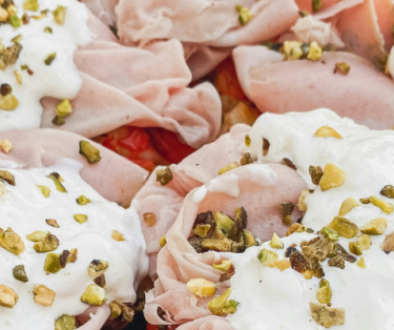
Mozzarella di Bufala Campana DOP is one of Italy’s most iconic fresh cheeses and the world’s best-known buffalo mozzarella. Its name can only be used for cheese made exclusively from fresh whole buffalo milk, produced and processed within a strictly defined geographic area, and following a tightly regulated production method. Its porcelain-white color, elastic texture, delicate lactic aroma, and fresh, slightly tangy flavor reflect centuries of cheesemaking tradition rooted in southern Italy, earning it the prestigious Protected Designation of Origin (DOP).
What’s the difference between DOP and PDO?
DOP stands for Denominazione di Origine Protetta, while PDO stands for Protected Designation of Origin. They are the same certification: DOP is the Italian term,  and PDO is its English/EU equivalent. This label guarantees that every stage of production, from raw materials, processing, and final product, takes place within a specific geographic area and follows an approved production specification.
For consistency, I will use DOP throughout this article, but note that it is interchangeable with PDO.
How Mozzarella di Bufala Campana gets its DOP label
Mozzarella di Bufala Campana is protected under the DOP scheme, meaning only cheese that complies with a detailed production specification may bear this name. The rules govern the production area, milk origin, animal husbandry, processing methods, physical and chemical characteristics, and even labeling and packaging.
Where can Mozzarella di Bufala Campana DOP be produced?
The milk production, cheesemaking, and packaging must all take place within a clearly defined area spanning multiple regions of southern and central Italy:
- Campania: Provinces of Caserta and Salerno (entire territories), parts of Naples and Benevento
- Lazio: Provinces of Latina, Frosinone, and Rome (specific municipalities)
- Puglia: Parts of the Province of Foggia
- Molise: Municipality of Venafro (Province of Isernia)
What ingredients can Mozzarella di Bufala Campana DOP contain?
| Must be made from | Permitted elements | Cannot contain (prohibited) |
|---|---|---|
|
|
|
How is Mozzarella di Bufala Campana DOP made?
Production begins with fresh whole buffalo milk sourced exclusively from registered farms within the DOP area. The milk must have a minimum fat content of 7.2% and a minimum protein content of 4.2%, and it must be processed within 60 hours of the first milking.
Milk coagulation occurs after heating to a temperature between 33°C and 39°C, using natural calf rennet. Acidification is achieved through the addition of a natural whey starter derived from previous buffalo milk processing.
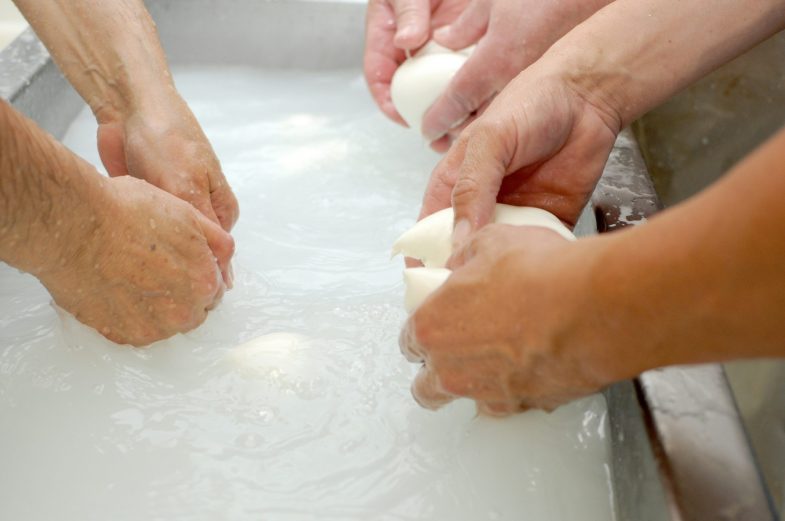
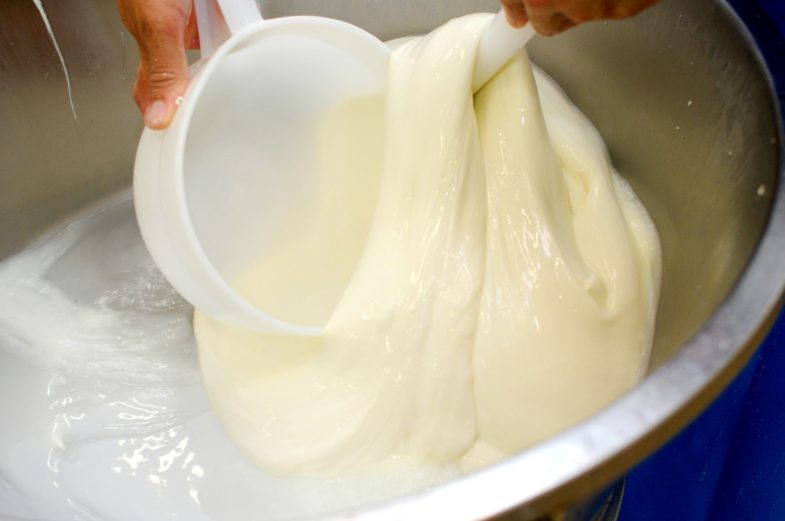
The curd matures under whey for several hours, typically around five, depending on microbial activity. Once matured, it is cut into strips, shredded, and mixed with boiling water. This step allows the curd to stretch (pasta filata process), after which it is shaped by hand or mechanically into its final forms.
The mozzarella is then cooled in potable water, salted in brine, and immediately packaged in its preserving liquid. Packaging must take place in the same facility where the cheese is produced.

Mozzarella di Bufala Campana DOP characteristics
| Organoleptic Characteristics | Chemical Characteristics |
|---|---|
|
|
Label and packaging of Mozzarella di Bufala Campana DOP
- Must display “Mozzarella di Bufala Campana” and “DOP” or “Denominazione di Origine Protetta”
- Must carry the official DOP mark issued by the protection consortium
- Must be packaged in the production facility
- Must be sold immersed in its preserving liquid
- Additional geographic qualifiers are prohibited
Sources
¹ Ansa, Mozzarella bufala campana, il 38,3% delle vendite all’estero, 2024.
² MASAF, Ministry of Agriculture, Food Sovereignty and Forests.